
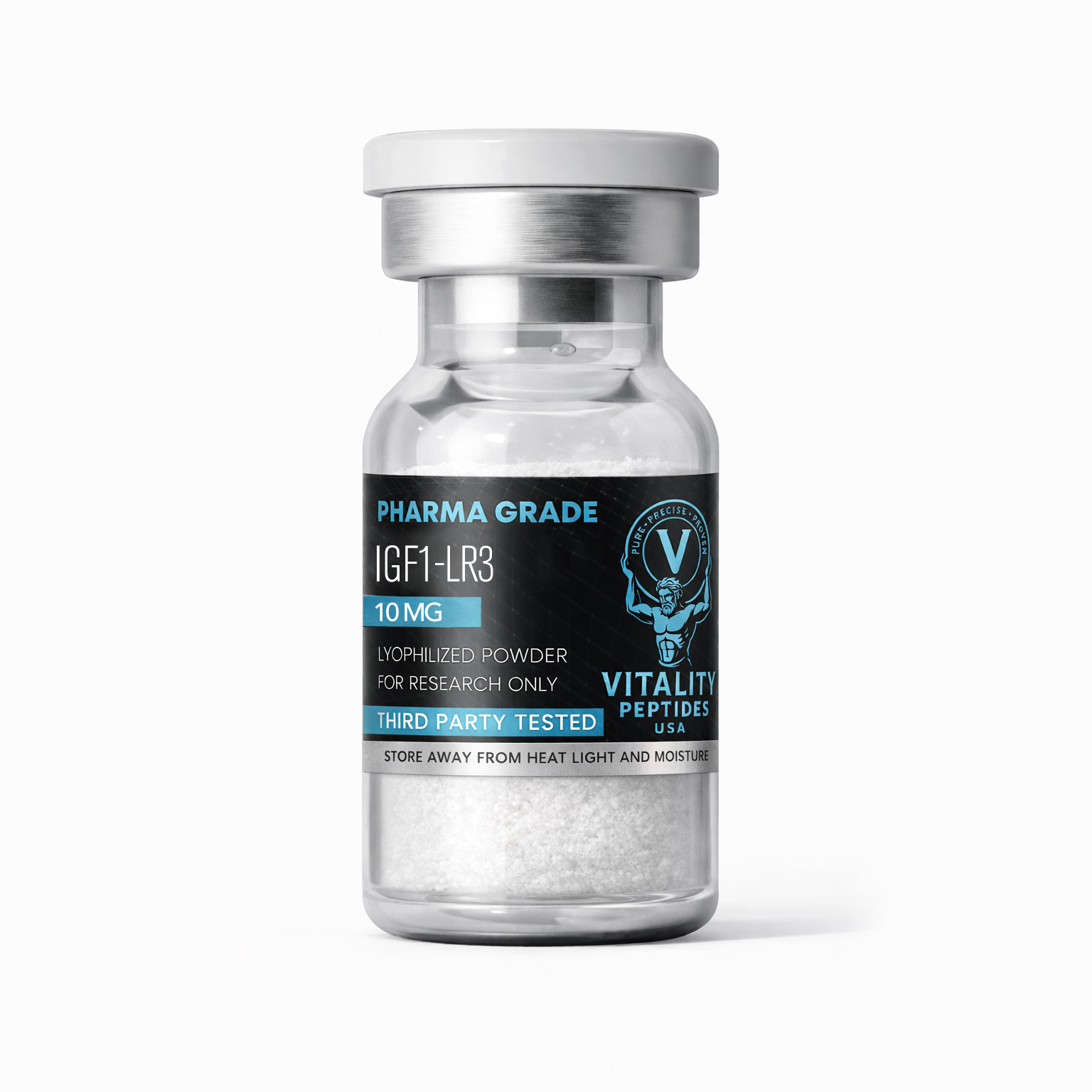
IGF1-LR3
$90.00
IGF-1 LR3 is a long-acting synthetic analogue of insulin-like growth factor-1 (IGF-1), engineered to extend half-life and improve stability in experimental studies. It is widely used in preclinical research to investigate muscle growth, protein synthesis, and cellular repair pathways. Researchers study IGF-1 LR3 to better understand anabolic signaling and tissue regeneration mechanisms in controlled laboratory models.
For in-vitro laboratory research only. Not a drug, food, cosmetic, or veterinary product. Not for human or animal administration.
Frequently Bought Together
Description
IGF-1 LR3
IGF-1 LR3 is a long-acting synthetic analogue of insulin-like growth factor-1 (IGF-1), designed to provide greater stability and an extended half-life compared with native IGF-1 in experimental research settings. Its modified structure makes it a useful research tool for investigating IGF-related signaling and downstream cellular processes under controlled laboratory conditions.
Research involving this compound commonly focuses on anabolic signaling, protein synthesis, muscle-related cellular pathways, tissue regeneration mechanisms, and cellular repair responses. IGF-1 LR3 is therefore of interest to researchers studying how IGF signaling influences cellular activity across different experimental models.
What Is IGF-1 LR3?
IGF-1 LR3 is a synthetic, modified form of IGF-1 developed for experimental research. The LR3 modification is associated with increased molecular stability and an extended half-life, making the compound particularly useful when researchers need to examine IGF-related signaling over longer experimental periods.
As an IGF-1 LR3 peptide, it is primarily investigated in research involving cellular signaling and growth-related biological pathways. Studies may examine how IGF-1-related mechanisms interact with protein synthesis, cellular regeneration, and tissue responses.
Its research relevance is centered on understanding biological mechanisms rather than positioning the compound as a therapeutic or performance-enhancing product.
IGF-1 LR3 Research Applications
IGF-1 LR3 research covers several areas of experimental biology, particularly pathways associated with IGF signaling. Researchers may investigate cellular responses to IGF-related activity and examine changes in protein synthesis or anabolic signaling under controlled conditions.
Another area of interest is muscle-related cellular research. The phrase IGF-1 LR3 muscle growth is often used when describing studies involving muscle cells and anabolic signaling, but it should be understood as a description of a research area rather than a claim that the compound produces muscle growth in humans.
Experimental models may also explore tissue regeneration and cellular repair pathways to better understand the biological mechanisms associated with IGF signaling.
IGF-1 LR3 and Recovery Research
IGF-related signaling has generated research interest in cellular repair and tissue response, which is why IGF-1 LR3 may sometimes be described as a recovery peptide.
In a laboratory setting, this terminology refers to research examining cellular responses following experimentally induced stress or injury. It does not indicate that IGF-1 LR3 is intended to accelerate recovery in humans or serve as a medical treatment.
Keeping this distinction clear is important when evaluating research compounds and the terminology used to describe them.
IGF-1 LR3 vs HGH
IGF-1 LR3 vs HGH is a common comparison in research discussions, but the two compounds represent different points within endocrine signaling research. IGF-1 LR3 is a synthetic analogue of IGF-1 and is used to investigate IGF-related cellular pathways, while HGH refers to human growth hormone, a different biological signaling molecule.
For laboratory purposes, they should not be treated as interchangeable research materials. Researchers comparing these compounds should consider their distinct molecular characteristics, mechanisms, and experimental applications rather than assuming equivalent activity.
Product Information and Selection
When evaluating IGF-1 LR3 for laboratory research, researchers should consider the product’s stated specifications, concentration, packaging, batch information, and available quality documentation.
Searches such as Buy IGF-1 LR3, IGF-1 LR3 for sale USA, or IGF-1 LR3 buy online may describe how researchers locate the compound, but purchasing terminology should not be confused with intended use. This product is supplied for laboratory research rather than personal administration or bodybuilding use.
The IGF-1 LR3 price should likewise be considered alongside product specifications and quality documentation rather than treated as the primary measure of product suitability.
Choosing an IGF-1 LR3 Supplier
A reliable IGF-1 LR3 supplier should provide clear product identification and transparent information about the research material. Researchers can evaluate available documentation, labeling, batch information, and stated specifications before selecting a compound for experimental work.
Clear research-use labeling is equally important because IGF-1 LR3 should not be presented as a supplement, medication, or consumer bodybuilding product.
Frequently Asked Questions
What is IGF-1 LR3?
IGF-1 LR3 is a long-acting synthetic analogue of IGF-1 studied in laboratory research involving IGF signaling, anabolic pathways, protein synthesis, and cellular repair mechanisms.
Why is IGF-1 LR3 studied in muscle research?
Researchers investigate IGF-1 LR3 in muscle-related models because IGF signaling is associated with cellular pathways involving protein synthesis and anabolic activity. Research findings should not be interpreted as evidence of human muscle-building effects.
Is IGF-1 LR3 the same as HGH?
No. IGF-1 LR3 is a synthetic analogue of IGF-1, while HGH is human growth hormone. They are distinct compounds involved in different parts of growth-related signaling research.
Why is IGF-1 LR3 described as a recovery peptide?
The term relates to experimental research into cellular repair and tissue-response pathways. It is not a claim that the compound is a recovery treatment for humans.
Is IGF-1 LR3 intended for bodybuilding?
No. Although IGF-1 LR3 bodybuilding is a common search term, this product is supplied for laboratory research and is not intended for bodybuilding, performance enhancement, or personal use.
Research Use Only
IGF-1 LR3 is supplied strictly for research and laboratory use. It is not intended for human or veterinary consumption, self-administration, bodybuilding, diagnosis, treatment, cure, or prevention of any disease or medical condition.
The information above describes research characteristics and areas of scientific investigation only. It should not be interpreted as medical advice or a recommendation for therapeutic or performance-enhancing use.
Related products
-

Ipamorelin
$65.00 Select options This product has multiple variants. The options may be chosen on the product page -

Tesamorelin Research Peptide
Price range: $85.00 through $125.00 Select options This product has multiple variants. The options may be chosen on the product page -
Sale!

CJC-1295/Ipamorelin Research Peptide
Price range: $75.00 through $95.00 Select options This product has multiple variants. The options may be chosen on the product page